
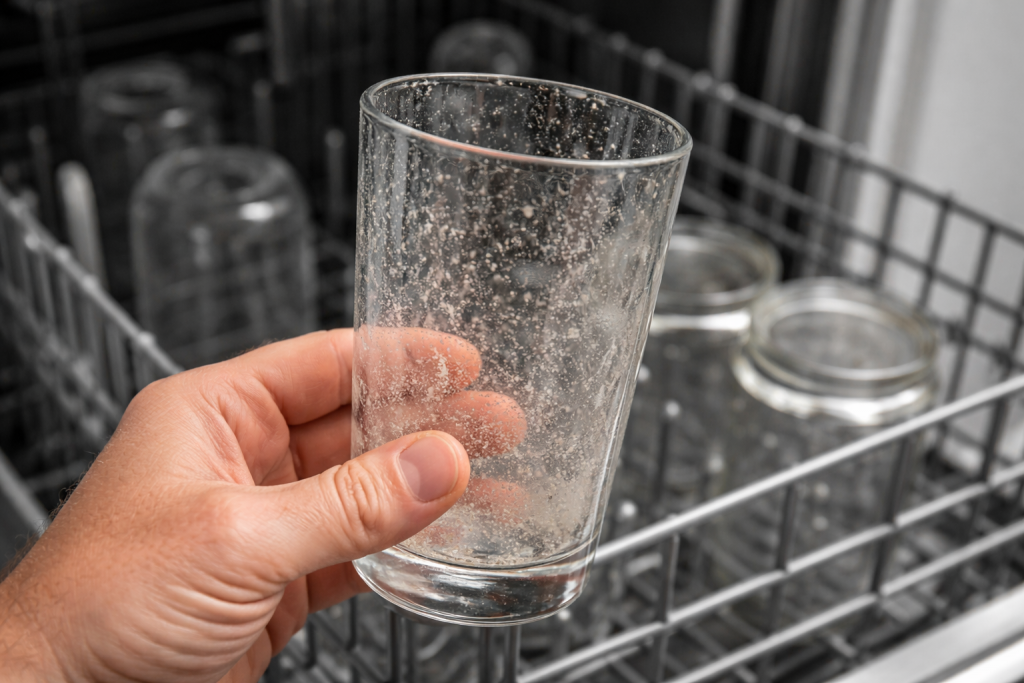
If you keep seeing dishwasher grit on glasses after a wash, it usually means debris is getting trapped somewhere and then rinsing back onto your clean items. Therefore, the fix is less about scrubbing every glass and more about finding the hidden spots where food soil and mineral bits collect.
In Quick & Pro Appliance Repair calls, this complaint often comes from a few repeat sources that are easy to miss during normal cleaning. However, once you know where grit hides, you can stop the cycle of “looks clean but feels sandy” and get clear results again.
Why grit shows up on clean glassware
Grit is typically a mix of tiny food particles, paper label residue, seed pieces, and hard water minerals that break loose late in the cycle. Consequently, you may not notice it on plates, but it stands out on clear glass because light makes the particles obvious.
Sometimes the dishwasher drains “enough” to pass, but not enough to remove the heavier bits. That is to say, the machine can sound normal while a small blockage keeps sludge in the sump area, ready to redeposit when the pump sprays again.
Where dishwasher grit on glasses hides most often
The filter area and sump pocket
Most modern units have a filter system that catches chunks before they reach the pump. However, when that filter is coated in greasy film or packed with fine debris, water flow slows and grit settles underneath. After that, the next wash stirs it up like a snow globe and it ends up on glassware.
Pull the lower rack, remove the filter parts, and rinse them under warm water. For example, a soft brush can lift trapped particles from the mesh without damaging it. Also wipe the sump pocket below the filter where heavy grit loves to sit.
The lower spray arm and its tiny holes
Spray arms can look clean from above, but the small jet holes can hold sand like residue. Consequently, the arm may spin, yet spray pressure becomes uneven and leaves grit behind.
Remove the lower spray arm if your model allows it and rinse it through. Moreover, run water through the center and check for blocked holes with a toothpick or a soft plastic pick, not metal. When spray patterns return to normal, glasses usually come out clearer.
The drain hose loop and sink connection
If the drain hose is not routed correctly, dirty water can flow back toward the tub. Therefore, grit that should leave the machine can return during draining and settle on the next rinse.
Check that the drain hose has a proper high loop under the sink or is connected to an air gap if your setup uses one. In other words, the hose should rise up before it goes down to the drain connection, so gravity cannot pull dirty water back into the dishwasher.
The dishwasher corners, door seal, and rails
Fine debris often sticks in corners and along the bottom edge of the door. Meanwhile, the door gasket can hold a thin line of gunk that breaks loose during a hot wash.
Wipe the door perimeter, the bottom lip, and the rack rails with a damp cloth. In addition, check the corners near the front of the tub where water movement is weaker and grit settles.
Detergent, loading, and water issues that make grit worse
Too much detergent can cause clumps that look like grit, especially with pods in soft water. However, too little detergent can leave soils floating around until the final rinse, which then deposits on glasses.
Hard water also creates a gritty feel when minerals bond with food residue. Consequently, you may see sandy particles plus cloudy film. If you notice both, adjust rinse aid and consider water softening options for your home.
Loading matters as well. For instance, if bowls block the spray arm or you pack glasses too tightly, water cannot flush particles away. Give glasses space, keep the spray arm path clear, and avoid nesting items.
Quick troubleshooting steps before calling for help
First, clean the filter and the sump pocket, then run a hot cycle empty with a dishwasher-safe cleaner. After that, wash a small test load of glasses on a normal cycle.
Secondly, confirm the spray arms spin freely and are not hitting tall items. Moreover, check the drain hose routing and the sink connection for buildup.
If grit still appears, the issue may be inside the pump area, a worn chopper system on certain models, or a drain restriction that needs proper diagnosis. At that point, Quick & Pro Appliance Repair can step in with a full inspection through our dishwasher repair service, and we can also share background details on our approach through the about page.
When grit signals a bigger problem
If you hear grinding, see standing water, or notice the unit is slow to drain, it may be more than routine cleaning. Therefore, running more cycles can spread debris further and stress the circulation pump.
Sometimes a kitchen drain issue contributes, and other times multiple appliances show symptoms of water quality or drainage problems. For example, if you also see residue or performance issues in laundry or cooking appliances, Quick & Pro Appliance Repair can help you compare symptoms across washer repair and stove repair visits, and even check airflow and lint factors when a home has ongoing cleaning and residue concerns that overlap with dryer repair.
Simple habits that keep glasses grit free
Rinse heavy soil off dishes, but do not fully prewash everything. That is to say, remove seeds, rice, and gritty bits, yet let detergent have enough soil to work with.
Clean the filter on a schedule that matches your cooking style. Moreover, run hot water at the sink before starting a cycle so the dishwasher fills with warmer water right away.
Lastly, keep rinse aid filled and match detergent type to your water. In conclusion, once you remove the hiding places and improve flow, dishwasher grit on glasses usually disappears fast.
FAQs
Why do I only see grit on glasses and not plates?
Glasses show particles more clearly because the surface is smooth and transparent. Therefore, tiny debris that blends into plates becomes obvious when it clings to glass after the final rinse.
Can a clogged filter really redeposit dirt onto dishes?
Yes, a packed filter slows water movement and lets debris settle in the sump. Consequently, the next spray can lift those particles and send them back onto glassware.
Do dishwasher pods cause gritty residue?
They can if the pod does not dissolve fully or if dosing is too strong for soft water. However, gritty residue can also come from food debris, so check the filter and spray arms first.
What is the fastest first fix for dishwasher grit on glasses?
Remove and rinse the filter parts, wipe the sump pocket, and flush the spray arm holes. After that, run an empty hot cycle with a cleaner and test with a small glass load.
When should I call a technician for grit problems?
Call when grit keeps returning after cleaning, when draining is slow, or when you hear unusual grinding. Most importantly, a proper diagnosis prevents pump damage and stops repeated redepositing.
